

Two of the most biologically active implants ever sold to orthopedic surgeons emerged from the U.S. government’s atomic energy research of the 1950s and 1960s. The first was Marshall Urist’s discovery of bone morphogenic proteins (BMP). The other is the subject of this article.
In 1967 a University of Florida professor, Dr. Larry Hench, was heading to a U.S. Army Materials Research conference in Sagamore, New York, when he chanced to sit next to an Army colonel just back from Vietnam.
“We can save lives but we cannot save limbs.”
After listening to Hench describe his radiation resistant ceramic the colonel posed a question that would change Hench’s life—and the lives of thousands of doctors and patients—forever. He said: “If you can make a material that will survive exposure to high energy radiation can you make a material that will survive exposure to the human body?”
The young colonel had witnessed numerous amputations in Vietnam. On that ride to the conference he told Hench “We can save lives but we cannot save limbs. We need new materials that will not be rejected by the body.”
It’s now been 45 years since that conversation and the new class of materials that it stimulated may well, finally, be ready to take the stage as the most exciting biologically active bone void fill since BMP.
BioGlass Is Born
Back at work after the conference, Hench recruited Ray Spintler and Drs. Ted Greenlee and Bill Allen to find an answer to the colonel’s question. The U.S. Army funded it.
In 1969 Hench, Spintler, Greenlee and Allen came up with a unique ceramic material which was a combination of CaO (calcium oxide), P2O5 (phosphorous pentoxide) in a Na2O-SiO2 (sodium silicate solution) matrix. They melted it into little squares and implanted them, along with a control, into a rat bone model.
Six weeks later Dr. Greenlee reported his results:
“These ceramic implants will not come out of the bone. They are bonded in place. I cannot push on them. I can’t shove them. I can hit them and they do not move. The control implants easily slide out.”
The U.S. Army Medical R&D Command would continue to fund this strange and obscure project for ten more years.
The new material proved to be extremely biocompatible, and integrated very well with surrounding bone or soft tissue by forming strong mechanical bond.
At some point someone named the stuff BioGlass.
So Close, Yet so Far
Some of the key discoveries about BioGlass which occurred between 1970 and 1980 were:
- The strength of the bond with bone was equal or greater than the strength of host bone.
- BioGlass’s bone bonding was the result of a rapid formation of hydroxy carbonate apatite bi-layer on the implant surface.
- The reactive layers of the ceramic enhanced absorption, desorption of growth factors and synchronized proliferation and differentiation of osteoblasts.
- Everything happens in 6-12 days in vitro and in vivo.

BioGlass came to market as a bone void fill. There was, however, a problem. Bone void fill is a non-load bearing application. Furthermore, any material used as bone void fill must be able to be resorbed over time.
And BioGlass did not resorb well, if at all.
Back then, BioGlass was essentially a form of crushed glass or glass microspheres. Porosity, such as it was, came in the form of the space between the small particles of bioactive glass.
Micro-channels in bone void fills (“porosity” in other words) are critical to bringing nutrients and cells to native bone for healing and eventual bone void fill resorption. While this worked with DBM (demineralized bone) or calcium based fills it didn’t with BioGlass.
Researchers tried to solve this problem by playing with the formulation. The next generation of BioGlass was, in effect, mostly calcium phosphate with a small amount of BioGlass. That solved the porosity problem. But it reduced the material’s bioactivity—which is the whole point of BioGlass.
So close, yet so far.
A New Way to Look at BioGlass
Charanpreet Bagga (“CB” to his friends and colleagues) in collaboration with Dr. Hyun Bae and MoSci Healthcare (which is the largest producer of BioGlass in the world) decided to look at BioGlass a new way.
CB, by the way, is the “go-to” guy for synthetic bone void fill research with 31 issued patents and another 44 in process. He spent the last quarter century leading product development at companies like Howmedica, Spinetech, Orthovita and Orthofix Spine. Dr. Hyun Bae is a world renowned orthopedic surgeon and scientist. Among his other accomplishments (which would take pages to list) is a research fellowship with the NIH (National Institutes of Health).
The CB/Bae/MoSci team decided to look at BioGlass in terms of surface area.
More surface area, more bone bonding. More bone bonding, more secure and long lasting the bone void fill.
BioGlass vermicelli.
The Vermicelli Solution
Looking at FIBERGRAFT through an electron scanning microscope it looks like vermicelli gone wild.
But each fiber is 100% bioactive glass. FIBERGRAFT leap frogs all other BioGlass type bone void fills.
The team then encased the miles and miles of winding strands into porous beads which they called “morsels” or BG Morsels.
In May 2014 this invention was implanted for the first time in humans by Dr. Daxes Banit in Georgia. Since then it’s been used in more than 200 surgeries.
BioGlass’s Anti-Microbial Effects
One of the likely side effects of increasing the surface area of BioGlass is that it will significantly increase the material’s natural anti-microbial effects as well. In a study titled: “Antimicrobial Effect of Nanometric Bioactive Glass 45S5” and authored by T. Waltimo, T.J. Brunner, M. Vollenweider, W.J. Stark, and M. Zehnder the authors wrote:
“The antibacterial effect of nanoparticulate bioactive glass appears to be directly linked to its high surface area.”
The authors went on to say high surface area BioGlass has the twin attributes of being able to re-mineralize bone as well as to dis-infect and increase the anti-bacterial efficacy of BioGlass.
FDA Cleared and Bone Formation Data
On March 14, 2014 BG Morsels were cleared by the FDA for commercialization as a 510(k) implant:
“…for bony voids or gaps that are not intrinsic to the stability of the bony structure. BG Morsels is indicated to be gently packed into bony voids or gaps of the skeletal system (i.e., the extremities and pelvis). These defects may be surgically created osseous defects or osseous defects created from traumatic injury to the bone. The product provides a bone void fill that resorbs and is replaced with bone during the healing process.BG Morsels is not indicated for use in load-bearing applications; therefore, standard internal or external stabilization techniques must be followed to obtain rigid stabilization.”
In animal models, BG Morsels have shown to grow new bone more effectively than either other forms of BioGlass or other bone void fill materials. The histologies in the diagram below illustrates this.

In animal tests (sheep and rabbit) BG morsels demonstrated impressive performance. One study (see chart below) compared BG Morsels to a positive control, the most popular BioGlass implant to date and then to a negative sham control (untreated defect) in a sheep model.
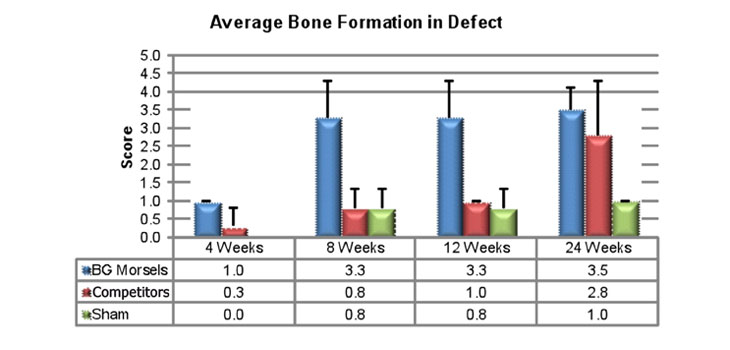
Make that a 58 skeletally mature sheep model. After 24 weeks with several interim evaluation points; (4, 8, 12, and 24 weeks) including a minimum of three animals per time point per treatment group, BG Morsels device demonstrated clearly superior bone formation in a defect.
In other animal studies where BG Morsels were compared to other popular synthetic bone void fills, BG Morsels were also able to stimulate higher rates of bone formation.
Fibergraft and Prosidyan
CB founded a company to bring his BG Morsels to market. He named it Prosidyan and he located it about 40 miles due west of New York City in Warren, New Jersey.
As he describes his new product, FIBERGRAFT BG Morsels, is, in effect, a matrix of bioactive glass microfibers and microspheres, encapsulated inside a porous egg shell. FIBERGRAFT creates an ultra-porous granular structure with, of course, miles of surface area.
Without a doubt, this has to be one of the most innovative synthetic bone void fill product of the last 30 years.
