


The nine winning companies with the BEST new spine care technologies for 2015 were: 7D Surgical, Aspen Medical Products, Benvenue, Cytonics, Invuity, LifeNet Health, LinkSPINE, SpineWave and Titan Spine.
Rewarding Innovation and Perspiration
This annual award rewards inventors, engineering teams, surgeons and their companies who’ve created the most innovative, enduring and practical products in 2015 to treat back pain. To win the Orthopedics This Week Best New Spine Technology Award for spine care, a new technology must meet the following criteria:
- Be creative and innovative.
- Have long-term significance to the problem of treating the diseases of the spine. Does this technology have staying power?
- Solve a clinical problem. To what extent does this technology solve a current clinical problem or problem that is inadequately solved today?
- Does it have the potential to improve standard of care?
- Is it cost effective?
- I would use it.
Our panel of surgeons score every submission on a scale of 1 to 5 (5 being the highest score) for each of the above criteria.
We and our panel of surgeons were impressed that inventors—despite ever growing hurdles to innovation and entrepreneurism in spine—still managed to create a solid group of nearly 40 new products to submit for the 2015 Orthopedics This Week Spine Technology Awards.
Submitters
We offer our thanks and deep appreciation to the engineering teams, surgeon inventors and the following companies for submitting their best ideas this year.
| 7D Surgical Inc. | Aspen Medical Products | Atlas Spine, Inc. |
| Augmenta Spine | Aurora Spine, Inc. | Benvenue Medical, Inc. |
| Biomet Spine | BioStructures, LLC | Cytonics Corporation |
| DePuy Synthes Spine | Genesys Spine | Intelligent Implant Systems, LLC |
| Invuity, Inc. | K2M Group Holdings, Inc. | LifeNet Health and DePuy Synthes |
| LinkSPINE | Medicrea USA | Medtronic Spinal & Biologics |
| Mighty Oak Medical | Misonix, Inc. | NLT SPINE |
| Orthofix | Ouroboros Medical, Inc. | Prosidyan, Inc. |
| Ranfac Corp. | Replication Medical, Inc. | SafeRay Spine, LLC |
| SafeWire | Simplify Medical, Inc. | Spinal Simplicity |
| Spine Wave, Inc. | Titan Spine LLC | Vexim |
| Xtant Medical |
The Judges
Our intrepid and detailed panel of surgeon judges included:
- Frank M. Phillips, M.D. Professor, Director, Section of Minimally Invasive Spine Surgery, Rush University Medical Center. Dr. Phillips specializes in minimally invasive cervical and lumbar reconstructive surgery. He also has expertise in motion preserving procedures and was a principle investigator in FDA trials on cervical disc replacement. Dr. Phillips is a leader in the field and is a founder, board member and past president of the Society of Minimally Invasive Spine Surgery. Dr. Phillips has participated in the development of and pioneered a number of minimally invasive spinal techniques that are now widely used. He regularly teaches and lectures to spine surgeons nationally and internationally on minimally invasive spinal surgery. Before coming to Midwest Orthopaedics at Rush in 2003, Dr. Phillips served as the director of the Spine Center at The University of Chicago and as a former member of the board of directors of Kyphon, Inc.
- Steven Garfin, M.D. Chair and Professor of Orthopedic Surgery University of California San Diego. Dr. Garfin has been involved in the design and assessment of new surgical techniques and instrumentation to treat spinal disorders. These include lumbar and cervical anterior plating systems, kyphoplasty to treat painful osteoporotic vertebral fractures, artificial discs, and biologic alternatives to bone grafts. His work has contributed to the development of current international standards in surgical care of the spine. Dr. Garfin has received multiple awards for research, teaching, and clinical care. He has published more than 260 articles, authored 123 book chapters, and edited nine books. Dr. Garfin has served as president, board member or program chair for each of the following national and international surgeon: American Academy of Orthopaedic Surgeons, American Orthopaedic Association, Cervical Spine Research Society, North American Spine Society, the International Society for the Advancement of Spine Surgery.
- Stephen Hochschuler, M.D. Co-founder and Chairman of the board of the Texas Back Institute. A graduate of Columbia College in New York, Dr. Hochschuler received his medical degree from Harvard Medical School. Dr. Hochschuler has been in private practice since 1977 and is licensed in seven states. In addition, he is a clinical instructor at the University of Texas Health and Science Center Southwestern Medical School. He has founded several medical-related companies. Dr. Hochschuler is a member of numerous national and international professional organizations including the American Academy of Orthopedic Surgeons; the American Pain Society; North American Spine Society; and the Southwest Chapter of the Society of International Business Fellows. Internationally, he is a member of the International Intradiscal Therapy Society; the International Society for Minimal Intervention in Spinal Surgery; the International Society for the Study of the Lumbar Spine; and is a founding board member of the Spinal Arthroplasty Society. He has also been a founding board member of The American Board of Spine Surgery and The American College of Spine Surgery.
- James D. Schwender, M.D. Spine surgeon at Twin Cities Spine Center and has served as president for the Society for Minimally Invasive Spine Surgery. He is a fellow of the Scoliosis Research Society and member of the North American Spine Society. In addition to his clinical practice, Dr. Schwender is one of the most prolific and respected researchers in spine surgery care. His presentations on minimally invasive spinal trauma surgery, biologics in lumbar fusion and safety in spinal procedures are a fixture at many surgeon society meetings. Dr. Schwender earned his medical degree at State University of New York and completed his residency in orthopaedic surgery at the University of Vermont. He was recently selected by his peers as one of the top 28 spine surgeons in the United States.
So, without further delay, here are the nine best new spine technologies for 2015 arranged in alphabetical order.

7D SURGICAL INC.
Winning Technology: Envision 3DTM: Image Guidance System
Inventors: Victor Yang, M.D., Ph.D., PEng, FRCSC, Beau Standish, PEng, Ph.D., Adrian Mariampillai, Ph.D., Michael Leung, MSc, Peter Siegler, Ph.D.
Envision 3D™ is an all optical intraoperative 3D image-guided surgical navigation system which does NOT have x-ray radiation. That’s right, no radiation. 7D’s image-guided surgical technology incorporates the form factor and function of the operating room surgical light and shines a special pattern onto the exposed patient anatomy. While this pattern is not visible to the operating room staff it is detectable by 7D’s Envision 3D™ device which then creates a highly accurate and detailed 3-dimensional surface.
 In just seconds, the intraoperative image is registered with the patient’s pre-operative CT or MRI scan.
Now, for the first time, surgeons can have real time 2D or 3D visualizations of the patient’s anatomy overlaid with the spatial positioning of the surgical tools with, again, no radiation. And with no diminution of image accuracy and detail.
Set up time for the Envision 3D™ is 1-2 minutes versus 15-30 with other imaged guided surgical navigation systems. Faster workflow, easier usability, extreme accuracy and no radiation risk.
No wonder Envision 3D™ from 7D is one of the best new technologies in spine for 2015.

ASPEN MEDICAL PRODUCTS
Winning Technology: Peak Scoliosis Bracing System
Inventors: Joel Perez, Geoffrey Garth, Steven Burke
Engineering Team: Pawel Buczek, Joe Horvath
The Peak Scoliosis Bracing System is a new type of bracing system which applies force to the patient’s spine by way of thoracic and trochanter pads on one side of the brace and by the belt, with or without a lateral pad, on the other side. The applied forces of this unique brace synergistically promote better alignment, reduced body lean and maximum pain relief.
 The brace’s SlickTrack tightening system has an independent upper and lower mechanism which delivers direct compression where needed. As the patient tightens the brace, the back panel naturally conforms to the patient’s lordosis.
Fundamentally, the Peak Scoliosis Bracing System is an unloader brace for the spine. It uses a traditional 3-point pressure system but does not rely on anterior or posterior struts. This minimalist structure allows the Peak system to be positioned unobtrusive laterally, beneath the arm.
Each brace is fit to the patient.

BENVENUE MEDICAL, INC.
Winning Technology: Luna 360 Interbody System
Inventor: James Lee, Jeff Emery, Laurent Schaller
Engineering Team: Andrew Huffmaster, Doug Lorang, Tim McGrath
Benvenue’s Luna 360 is an expandable PEEK-OPTIMA interbody implant that forms an ALIF footprint from a mini-open or MIS posterior approach. It is designed to deliver anterior column stability, strength and fusion with minimal neural retraction.
 One of the Luna’s key features is that it has a controlled, non-impaction delivery capability and a generous graft window that allows the surgeon to insert bone grafting material post expansion. This is a very important attribute as any spine surgeon can attest.
But words alone can’t convey the uniqueness of the Luna 360 invention. Here is what it looks like. In particular, notice the footprint and that huge interior space for bone graft material.
The differences from currently available expandable interbody cages should be immediately obvious—as they were to this year’s spine award judges.

CYTONICS CORPORATIONS
Winning Technology: Autologous Protease Inhibitor Concentrate (APIC)—CF System
Inventors: Lewis Hanna, Ph.D., Shawn Browning, Ph.D., Gaetano Scuderi, M.D. Katie Dent
The APIC-CF is a system for concentrating and purifying the naturally occurring serum protein Alpha-2-Macroglobulin (A2M) from a patients’ blood at point of care. A2M is a potent inhibitor of ALL KNOWN enzymes that degrade collagen and proteoglycans in cartilage. Importantly, in vivo efficacy of the APIC-CF was demonstrated to inhibit osteoarthritis in a rabbit model. The ability of APIC-CF to inhibit the protease and catabolic enzymes involved in collagen and proteoglycan degradation in cartilage has shown that APIC-CF is also efficacious at inhibiting the proteoglycan degradation inherent in disc degenerative disease (DDD)
 A study of 24 patients with lower back pain and MRI positive for DDD were treated with concentrated autologous A2M with highly positive outcomes. The 13 males and 11 females were first tested for a biomarker associated with lumbar disc disease (fibronectin-aggrecan complex or FAC). Twelve discs were FAC positive in 10 patients out of 40 discs tested. When A2M was injected in FAC positive patients, the VAS improvement was 4.9 +/- 0.9, versus 1.5 +/-1.2 in patients with negative FAC. Similarly ODI scores in patients treated with A2M improved an average 37 +/- 9.3 points in FAC positive patients versus 9.4 +/- 11.9 in FAC negative patients.
Cytonic’s products bridge the gap between the presence of a biomarker for DDD pain and clinical outcomes. APIC-CF is a true theranostic and has widespread implications for disruptive treatment of degenerative disc disease.

INVUITY, INC.
Winning Technology: Waveguide XT System
Inventors: Alex Vayser
Engineering Team: Michael Boutillette, Vladimir Zagatsy
The Waveguide XT is a “Drop-In Illuminator” meaning that it can ride along your retractor (it is compatible with any retractor) to shine brilliant, thermally safe light anywhere along the incision to illuminate the entire surgical cavity.
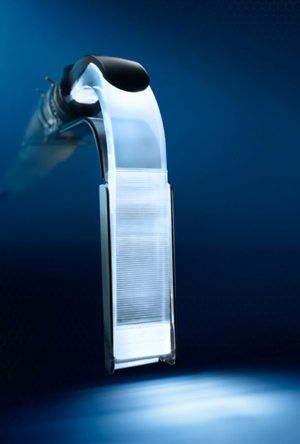 Think of it. For the first time a surgeon can direct light—cool, brilliant, bright—into and throughout the entire surgical cavity by way of attaching the light source to the actual instruments like retractors.
The core technology behind these remarkable technologies as Invuity’s patented Photonic technology which directs and shapes lights into broad, uniform, volumetric and thermally cool illumination. The light output comes via fiber optic cable which is coupled with a solid core optical polymer to maximize light output while minimizing heat. The complex geometry of the cable’s microstructures eliminates shadows and glare. Result: broad, uniform and brilliant, redundant illumination where you want it. In the surgical cavity.

LIFENET HEALTH & DEPUY SYNTHES
Winning Technology: ViviGen
Inventors: Silvia Chen, Ph.D., Roberto Bracone, JingSong Chen, Ph.D.
Engineering Team: Glenna Wallis, Heather Scott, Angela Murchison, Evans Wralstad, Patrick Gazzolo, Patrick Sachs, Ph.D., Bart Gaskins, Dennis Phelps, Payal Sohoni, Joe Peterfeso, Mike Tyskowski, Mark Evans, Heather Germany, John Hartzell, Uzair Rajput
ViviGen is the first cellular allograft to focus on recovering, processing and protecting viable lineage committed bone cells. New evidence supports the use of bone cells instead of MSC’s for bone healing. It is made of viable cryopreserved corticocancellous bone matrix and demineralized bone. Because of its properties, ViviGen can be considered to be an alternative to autograft.
 The key to ViviGen’s ability to achieve the highest level of bone cell viability and to identify factors that might reduce cell viability is LifeNet’s care in selecting the right cell lineage, processing the allograft from recovery to implantation which maintains cell viability and, finally, the meticulous way in which LifeNet scrutinizes each processing step.
Finally, ViviGen’s bone cells are preserved for grafting in the operating room in such a way as to maintain 96% cell viability post-thawing.

LINKSPINE
Winning Technology: FacetLINK HEMI
Inventors: Harm-Iven Jensen, Helmut D. Link
Engineer: Harm-Iven Jensen
FacetLINK HEMI is a rigid plate which has been designed in such a way that the surgeon can cross-connect the transfacet pedicle screw on the ipsilateral side of a microdecompression to a translaminar facet screw on the contralateral side.

Bilateral decompression is an increasingly popular approach since it significantly reduces surgical site morbidity. LinkSPINE’s new FacetLINK HEMI offers more functionality to this MIS approach by giving the surgeon instrumentation which can access the surgical site via the same incision and facilitate the crossover technique.
Again, FacetLINK HEMI allows the surgeon to perform the crossover technique via the small, bilateral decompression incision. This less invasive approach avoids the lateral soft tissue dissection and retraction which is otherwise necessary to implant conventional, pedicle screw based instrumentation.

SPINEWAVE
Winning Technology: Leva™ PX Interbody Device
Inventors: Hughes Malandain
Engineering Team: Hughes Malandain
The Leva PX is an expandable titanium interbody cage which has been designed in such a way as to optimize the surgeon’s ability to insert maximum amounts of bone graft material. Being that it is titanium, the Leva PX is structurally strong and being expandable it also helps to restore disc height.
 The Leva PX is a one-piece titanium implant (far left image) which opens up (no gears, no screws) into a spacer (far right image). Up to 68.5% of the implant volume can be packed with bone graft material. And the surgeon can also pack bone graft into the surrounding, evacuated disc space.
Finally, the Leva PX has a 4mm Retractable bullet nose which makes for easy insertion.

TITAN SPINE LLC
Winning Technology: nanoLOCK Surface Technology
Inventors: Mark Berg, Jennifer Schneider, Peter Ullrich, Chad Patterson
Engineering Team: Michelle Gallagher, Kelly McDonnell, Kenneth Roggow
Many companies talk nanotechnology, but only Titan Spine’s nanoLOCK has the FDA imprimatur for nanotechnology. And this year’s panel selected it as one of 2015’s best technologies for spine surgery.
Titan’s nanoLOCK surface technology provides texture at the nano scale as well as the macro and micro scales and that particular ability has been shown in numerous studies to upregulate osteogenic and angiogenic growth factors. Who needs BMP2?

Titan’s next generation nanoLOCK surface technology will be commercially launched in Q4, 2015.
The great promise of putting this type of surface technology at the nanomaterial level is faster bone healing and angiogenesis following interbody fusion surgery. This approach works at the cellular level through a biochemical process. It is, fundamentally, an active participant in the fusion process.
Again, this is the first FDA-cleared nanotechnology for the treatment of spinal disease. In addition, the core material is titanium and titanium alloys, which are well known to deliver superior biocompatibility and mechanical properties to implants in the spine. Now, with nanoLOCK, it also delivers osteogenesis and angiogenesis.
